
How Lawyers Build a Strong Mandamus Record Against IRCC Delays
Strong mandamus cases are rarely won by emotion alone. Delay may feel unfair, stressful, or even absurd, but in Federal Court what matters most is the record. A persuasive mandamus case is built by showing, in a disciplined way, that the government had a duty to act, that the applicant did what was required, that the file was allowed to drift beyond what the process reasonably required, and that the explanations offered do not hold up against the actual history of the file.
That is why experienced counsel do not approach a delay case by simply saying that the application has been pending for too long. They build an evidentiary record that allows the Court to see what happened, what did not happen, and why the delay has become legally vulnerable.
1. Timeline building: the foundation of the case
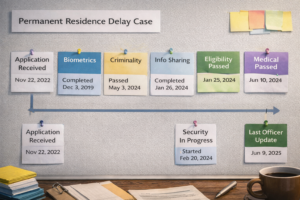
The first task in a serious mandamus file is to build a clean, detailed chronology. This usually begins with the submission date, acknowledgement of receipt, biometrics, medicals, document requests, eligibility review, criminality, security-related notations, transfers between offices, and any later requests for updated materials.
The reason this matters is simple: delay is contextual. Courts repeatedly treat reasonableness as a fact-specific inquiry, not a mechanical exercise. A lawyer needs to show not just how much time passed, but where the file appears to have slowed, stalled, or gone quiet. A well-built timeline often reveals long periods of inactivity, repeated six-month bring-forward notes, unexplained silence after key steps, or movement that appears only after litigation pressure begins.
In strong cases, the timeline also helps separate ordinary processing from suspicious stagnation. That distinction can be critical.
2. GCMS analysis: reading the file behind the file
GCMS notes are often one of the most important tools in a mandamus case. They help reveal what IRCC actually did with the file, which internal steps were completed, what remained outstanding, whether security or background checks were invoked, and whether there were long periods where little or nothing appears to have happened.
A proper GCMS review is not just about finding a single helpful line. It is about reading the file as a process record. Lawyers look for patterns such as eligibility being completed long ago, criminality being passed, security remaining ‘in progress’ without meaningful detail, repeated bring-forward entries, or internal notes showing that the file was simply left pending.
In some cases, the GCMS notes also expose a mismatch between what the applicant was being told and what the file actually showed. That can become highly important where the client received only vague status updates while the internal record reflected prolonged inactivity or no concrete explanation at all.
3. Follow-up correspondence: proving diligence and prior demand
Mandamus is not just about showing delay. It is also about showing that the applicant sought performance of the duty and gave the decision-maker a fair opportunity to act. That is why lawyers gather webform submissions, email chains, ATIP requests, Member of Parliament inquiries, status requests, and any replies received from IRCC.
This correspondence serves several purposes. First, it shows diligence on the part of the applicant. Second, it helps demonstrate that the applicant did not simply disappear and then suddenly litigate. Third, it often highlights the quality of IRCC’s explanations. If the file history shows months or years of generic responses such as ‘still under review’ or ‘security screening is ongoing’ without meaningful particulars, that can help support the argument that the delay has not been satisfactorily justified.
Repeated, unanswered, or non-substantive follow-ups can therefore become an important part of the record.
4. Evidence of prejudice: not always required, but often powerful
Not every mandamus case depends on dramatic hardship. But evidence of prejudice can still be very helpful. It shows the Court that the delay is not merely theoretical or administrative. It is affecting real lives, real plans, and real opportunities.
Depending on the file, this prejudice may include family separation, inability to start a life in Canada, uncertainty affecting children, business disruption, missed professional opportunities, inability to access status-dependent employment, repeated expiry of medicals or criminality checks, or prolonged mental strain caused by years of uncertainty.
Careful lawyers do not exaggerate this evidence. They document it. The strongest records usually connect the prejudice directly to the delay itself and explain why the harm has compounded over time.
5. Comparable processing evidence: establishing the baseline
Published processing times are not guarantees. Courts have said that clearly. But they still matter. They provide a baseline for understanding whether a file is prima facie taking longer than the nature of the process usually requires.
Lawyers therefore often use IRCC’s own published estimates or service standards as a reference point, not as an automatic entitlement. If a file has been pending for several multiples of the usual timeframe, that does not end the analysis, but it does strengthen the need for a real explanation.
Comparable evidence can also come from the structure of the file itself. For example, if other key steps were completed long ago and only one vague screening reference remains, the delay may be harder to justify. The point is not to argue that every file must move identically. The point is to show that this file appears materially outside the ordinary range without a persuasive reason.
6. Testing IRCC’s explanations
A central part of a mandamus record is testing whether the government’s explanation actually explains the delay. Courts have repeatedly rejected generic or blanket statements when they are unsupported by specifics. Simply saying that security checks are important, that partner agencies are involved, or that the pandemic affected operations does not automatically justify years of delay.
A strong record therefore puts pressure on those explanations. Was there evidence of actual complexity? Was any concrete concern identified? Was there meaningful activity during the period of delay? Was most of the delay already in place before the pandemic? Was the file effectively parked with repeated review dates and no real movement?
The more the government’s justification looks abstract while the record looks silent, the stronger the mandamus case tends to become.
7. Identifying periods of inactivity
Many successful mandamus files contain one especially important feature: identifiable stretches where nothing meaningful appears to have happened. Lawyers look for these quiet periods carefully.
Sometimes the file shows that security or background screening was invoked and then the record goes cold. Sometimes there are long gaps between internal reviews. Sometimes the file was progressing and then stalled after being transferred. In other cases, IRCC kept asking for updated forms or refreshed documents only because so much time had passed without a decision.
These periods of inactivity matter because they help turn a general complaint into a precise argument. The question becomes not just ‘why is this late?’ but ‘what explains this particular period where the file appears to have sat without meaningful progress?’
8. Framing the relief carefully
Strong mandamus advocacy is also about asking for the right relief. Lawyers do not usually ask the Court to approve the application itself. The public duty is generally to process the file and provide a lawful outcome, not to grant status automatically.
That means the requested relief must be framed with care. In some cases, the appropriate request is a decision within a fixed period. In others, the more strategic focus may be to compel completion of a stalled internal step, require the file to move forward, or obtain clarity about where the file stands in the queue or process.
Careful framing matters because it shows the Court that the applicant is not asking for an improper shortcut. The applicant is asking the Court to require lawful, timely performance of the duty that already exists.
9. Why method matters
A delay case built only on frustration can be dismissed as impatience. A delay case built on chronology, GCMS evidence, documented follow-ups, demonstrated prejudice, and careful legal framing is something very different.
Method matters because Federal Court judges are not simply deciding whether a delay feels unfair. They are deciding whether the legal test for mandamus has been met on the record before them. The stronger, cleaner, and more disciplined that record is, the harder it becomes for vague explanations to survive.
That is why effective mandamus work is usually less dramatic than people think. It is forensic. It is patient. And it is built case by case.
Final takeaway
The strongest mandamus files are built, not declared. They are built through timelines, GCMS analysis, follow-up history, evidence of prejudice, and careful attention to what relief is actually appropriate.
That approach does more than strengthen the legal case. It also shows the Court that the applicant is not reacting emotionally to delay, but presenting a structured and evidence-based record of why the delay has become unreasonable. In immigration mandamus work, that difference can be decisive.
Frequently Asked Questions
What makes a mandamus record strong?
A strong mandamus record usually includes a detailed timeline, GCMS notes, documented follow-ups, evidence that the applicant complied with requests, proof of prejudice where available, and a careful explanation of why the delay has not been satisfactorily justified.
Are GCMS notes important in mandamus cases?
Yes. GCMS notes often help show what steps were completed, what remained outstanding, and whether there were long periods of inactivity or only vague references to ongoing review.
Do lawyers need to prove hardship in every mandamus case?
Not always. But evidence of hardship or prejudice can still be very helpful because it shows the real impact of the delay and helps the Court understand why the matter is not just administratively late, but practically harmful.
Can a mandamus case succeed if IRCC says security checks are ongoing?
Sometimes yes. Courts have often found that generic references to security screening are not enough on their own. What matters is whether there is a concrete, file-specific explanation that actually justifies the length of the delay.
If your immigration file has been delayed and you want a careful legal assessment of whether the record is strong enough for mandamus, email us at legal@canadianfuture.ca.
Legal Information Disclaimer
The information provided here is for general informational purposes only and should not be considered legal advice. The content on this site is not intended to create, nor does it constitute a lawyer-client relationship. It’s important to consult with a qualified attorney for advice on your specific legal issues.
No responsibility is assumed for any reliance on the information contained herein, and Canadian Future disclaims all liability with respect to such information. This site may not reflect the most current legal developments; therefore, the information here should not be used as a substitute for legal advice from a licensed professional attorney in your jurisdiction.