



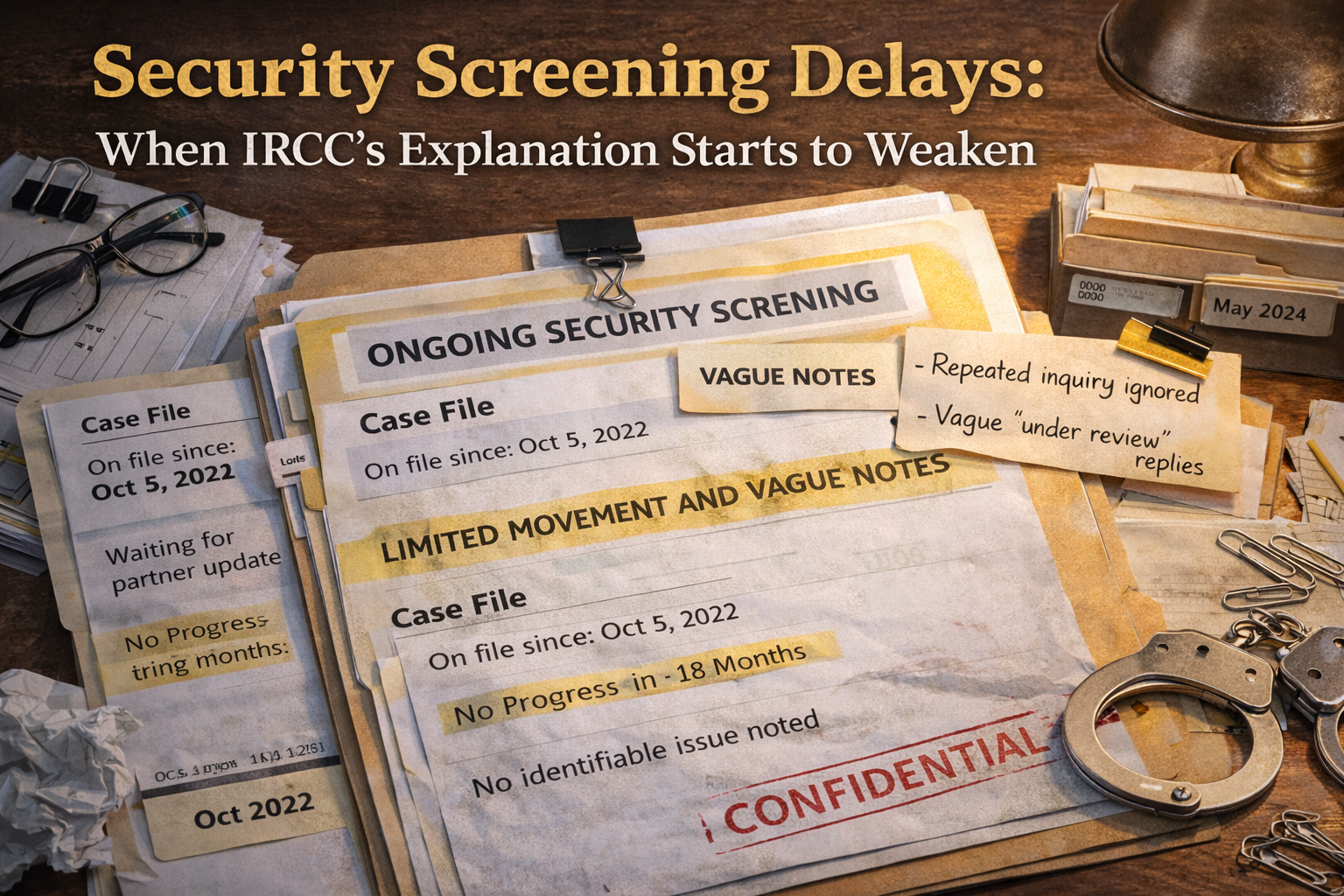
Security Screening Delays: When IRCC’s Explanation Starts to Weaken
Security Screening Delays: When IRCC’s Explanation Starts to Weaken
One of the most common explanations given by IRCC in delay cases is that the file is pending security screening or awaiting information from partners. That explanation may sound serious, and sometimes it is. But it is not a complete answer by itself.
In delay litigation, the real question is not whether security screening exists as a valid part of the immigration process. Of course it does. The real question is whether the government has provided enough information to justify the particular length of the delay in the particular file. A vague reference to screening may identify the stage where the file is stuck, but it does not automatically explain why the file has remained there for so long.
That distinction matters because many delayed immigration files contain the same kind of language: pending screening, awaiting info from partners, under review, or approved pending information from partners. These labels can be important, but they are not self-proving. If the surrounding record shows very limited movement or long inactivity, the explanation may start to weaken.
Security screening is important, but not self-justifying
No serious delay analysis should minimize the importance of security screening. IRCC is entitled, and indeed required, to carry out admissibility-related reviews where appropriate. Courts recognize that public safety and system integrity matter.
But recognizing the importance of security screening is not the same thing as accepting that every delay associated with it is automatically reasonable. The existence of a screening process does not relieve the government of its obligation to explain why a file has taken as long as it has. Where screening is invoked, the question remains whether the record gives enough concrete, file-specific information to justify the duration.
Why a generic screening explanation may not be enough
A generic explanation starts to weaken when it remains abstract while the file history stays silent. For example, if the only evidence is a GCMS note saying that security is in progress or that information is awaited from partners, that may show the label attached to the file, but not the reason for the extraordinary length of the delay.
Courts have repeatedly distinguished between a real explanation and a bare assertion. A real explanation usually gives some insight into the nature of the concern, the steps being taken, the timing of those steps, or why the matter falls outside ordinary processing. A bare assertion simply repeats that screening is ongoing and asks the Court to accept the delay on trust.
That kind of trust tends to weaken where the government provides no direct evidence from anyone with knowledge of the file and instead relies on generic affidavits, generalized website material, or unspecific GCMS entries.
What the record often shows in weaker cases
In weaker justification cases, the file often shows one or more of the following features.
First, screening appears to have started long ago, but the record contains little or no visible progress after that point.
Second, the GCMS notes use broad labels such as pending screening, admissibility under review, or approved pending info from partners, without identifying any concrete case-specific concern.
Third, the applicant receives only generic status responses despite repeated follow-ups.
Fourth, the government files affidavits from Department of Justice personnel with no direct knowledge of the processing history and no evidence explaining what actually caused the delay.
Fifth, activity appears only at the very end of the case, sometimes shortly before a hearing, which may suggest last-minute movement rather than a genuinely active file throughout.
When security screening may genuinely justify more time
Security screening is not always a weak explanation. In some files, the record may disclose an actual and evolving concern that requires additional investigation. That may include a procedural fairness process, requests for records tied to a concrete issue, interviews, clarification of military or law-enforcement service, or other steps showing that the file presents a real and identified complexity.
Where the record reveals that kind of specific concern and shows meaningful activity connected to it, the government’s explanation may carry more weight. The point is not that security screening can never justify delay. The point is that it has to be shown, not just invoked.
Why timing matters so much
Timing is often where the government’s explanation begins to lose force. If a file entered security-related review many months ago and there is still no meaningful update, no identified complexity, and no evidence of concrete steps being taken, the legal problem becomes harder to ignore.
This is especially true where the delay far exceeds ordinary processing ranges by several multiples. At that point, the issue is no longer merely that screening exists. The issue is whether the government has shown enough to explain why this file remains stuck for this long.
A file can therefore move from understandable delay to legally vulnerable delay if time keeps passing without specific explanation.
The role of GCMS notes in testing the explanation
GCMS notes are often central to this analysis. They may reveal when screening first appeared, whether later steps occurred, whether procedural fairness was initiated, whether partner information was actually received, or whether the file simply sat with the same status for long periods.
They can also reveal what is missing. Sometimes the notes say only that the file is pending screening, but do not identify the issue, the partner involved, or any timeline of activity. In other files, the notes contain discrepancies across versions, or late-added entries that appear only after litigation pressure has begun.
That is why GCMS notes are best treated as a diagnostic tool, not a magic answer. They help test whether the government’s explanation matches the actual processing history.
Why partner involvement does not end the analysis
Another common argument is that security screening may involve other government partners and is therefore outside IRCC’s direct control. Even where that is true, it does not end the legal analysis.
If IRCC relies on partner involvement to justify delay, the government still has to provide enough evidence to explain why the delay has lasted as long as it has. Simply saying that another agency may be involved does not remove the obligation to justify the delay on the record before the Court.
In other words, partner involvement may explain part of the process. It does not automatically excuse an absence of evidence.
Why last-minute movement may not save the delay
Sometimes a file suddenly moves shortly before a hearing or after litigation has already begun. An interview is scheduled. A note is added. A procedural step appears. That movement can be important, and it may even be meaningful. But it does not automatically erase the long period of unexplained delay that came before it.
Courts can recognize a late step as progress while still finding that the file was allowed to drift too long without proper justification. Late movement may help show that the file can move. It may also reinforce the impression that meaningful steps were not being taken earlier.
What applicants and referral partners should take from this
The key lesson is that security screening should be taken seriously, but not treated as an automatic legal shield. If the record shows a concrete issue, evolving action, and file-specific complexity, the explanation may be stronger. If the record shows only vague notes, bare assertions, and long inactivity, the explanation may begin to weaken considerably.
For applicants and referral partners, this means the real work is in the record. The question is not simply whether IRCC has said the word security. The question is what the file history, GCMS notes, correspondence, and evidence actually reveal about the nature and timing of the delay.
Final takeaway
Security screening is one of the most common explanations for immigration delay. But it does not automatically end the legal analysis. A generic reference to pending screening or partner consultation may grow weaker over time if the file history shows little movement, no specific concern, or prolonged inactivity.
In strong delay cases, the issue is often not whether security screening exists. It is whether the government has actually justified the length of the delay in a meaningful, file-specific way.
Frequently Asked Questions
Does security screening automatically justify a long immigration delay?
No. Security screening is an important part of the process, but the government still has to provide enough evidence to justify the particular length of the delay in the particular file.
If GCMS notes say 'pending screening,' does that answer the legal question?
Usually not. That kind of entry may identify the stage where the file is stuck, but it does not by itself explain why the delay has lasted so long.
Can IRCC rely on other agencies or partners to explain the delay?
IRCC may point to partner involvement, but that does not remove the need to justify the delay with sufficient evidence. Partner involvement is not a complete answer by itself.
What makes a security screening explanation stronger?
It is stronger when the record shows a concrete concern, meaningful activity, case-specific steps, or a clear explanation of why the file falls outside ordinary processing timelines.
If your immigration file has been delayed and IRCC is relying on security screening without giving a meaningful explanation, email us at [email protected] for a tailored review of the file history and GCMS record.
Legal Information Disclaimer
The information provided here is for general informational purposes only and should not be considered legal advice. The content on this site is not intended to create, nor does it constitute a lawyer-client relationship. It's important to consult with a qualified attorney for advice on your specific legal issues.
No responsibility is assumed for any reliance on the information contained herein, and Canadian Future disclaims all liability with respect to such information. This site may not reflect the most current legal developments; therefore, the information here should not be used as a substitute for legal advice from a licensed professional attorney in your jurisdiction.
Leave a comment