



What GCMS Notes Can Reveal About a Delayed Immigration File
What GCMS Notes Can Reveal About a Delayed Immigration File
When an immigration file has been delayed for months or years, many applicants assume that GCMS notes will finally contain the answer. Sometimes they help a great deal. Sometimes they do not. The better way to understand GCMS notes is not as a magic solution, but as a diagnostic tool.
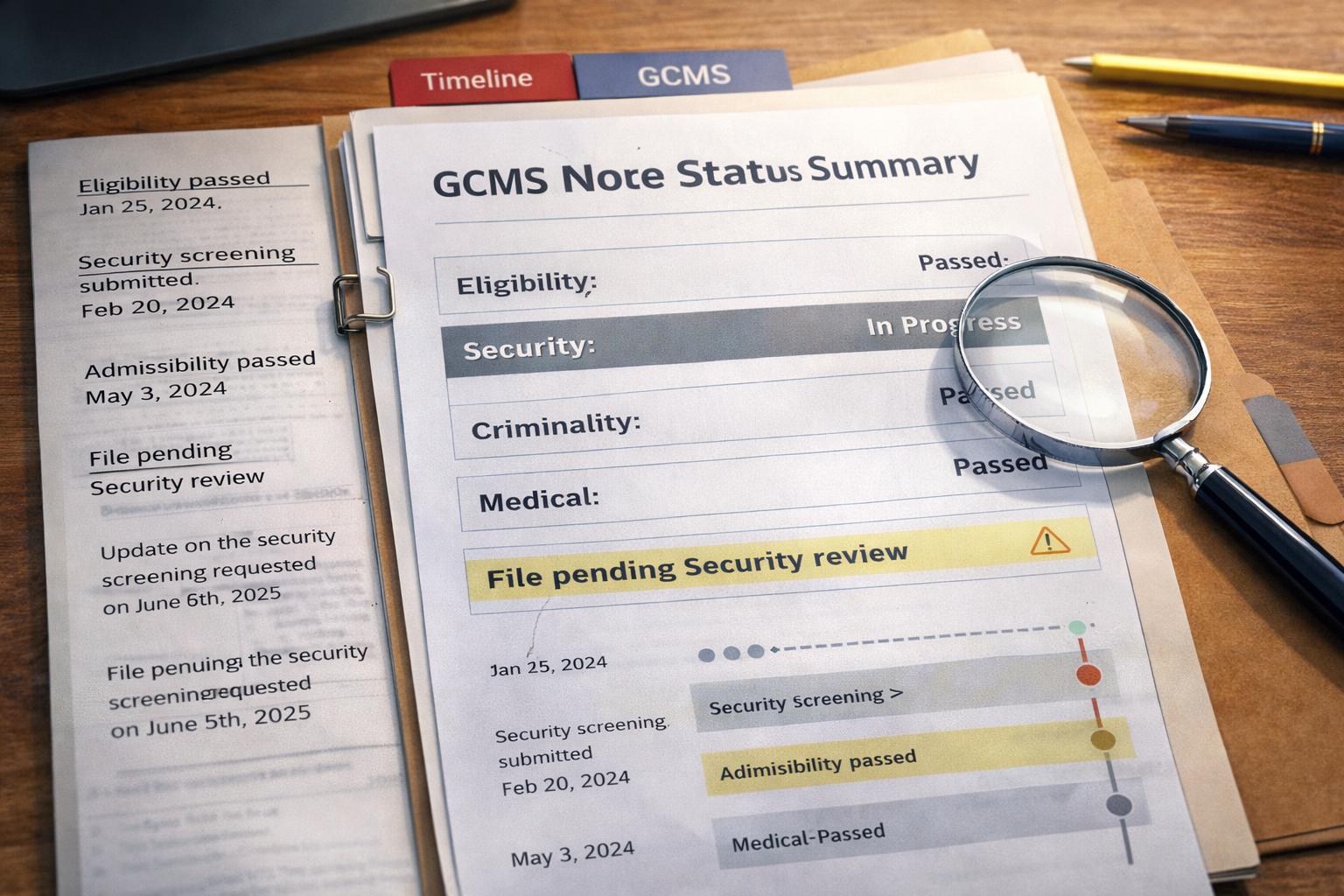
GCMS notes can help reveal what steps IRCC has taken, what remains outstanding, whether the file has moved between offices, whether eligibility has started, whether security-related review appears pending, and whether long periods passed with little or no meaningful activity. They are often one of the most useful documents in delay analysis, especially when the client has received nothing more than generic status replies.
At the same time, GCMS notes do not always tell the whole story. They may be incomplete, partially redacted, restricted, or too vague to explain why a file has stalled. That is exactly why they have to be read carefully and in context.
What are GCMS notes?
GCMS stands for Global Case Management System. It is the internal system used by IRCC to track immigration applications and many of the steps taken on a file.
When requested through access-to-information channels, GCMS notes can provide a snapshot of the file’s internal history. They often show dates, officer notes, status fields, document requests, file transfers, and references to eligibility, criminality, admissibility, medicals, and security-related processing.
For delayed files, that internal history can be far more informative than the short messages applicants usually receive through webforms or online account updates.
Why GCMS notes matter in delayed files
In many delay cases, the issue is not simply that the file is old. The issue is that nobody outside IRCC can tell what has actually happened inside the file. GCMS notes help reduce that opacity.
They can show whether the application was reviewed early and then went quiet, whether one internal step was completed long ago while another remains unresolved, or whether the file appears to have been sitting with repeated bring-forward dates and little real progress.
Courts have often treated this kind of internal evidence as important in assessing whether delay is truly unexplained. Where the government offers only generalized statements, GCMS notes may expose whether the actual file history supports that explanation or not.
What GCMS notes may reveal
One common insight is whether eligibility has started or been completed. In some files, eligibility is passed relatively early, while the file remains pending on admissibility or background-related issues. That can matter because it shows the application is not frozen at the front end; it is stuck later in the process.
GCMS notes may also show whether security screening or another admissibility-related step is marked as in progress. That kind of entry can be useful, but it has to be treated carefully. A note saying that screening is pending does not automatically explain why a long delay is justified. The real question is whether the record provides any concrete information about the nature of the issue or the reason for the duration.
The notes may further reveal whether medicals expired and had to be renewed, whether IRCC requested updated documents because so much time had passed, or whether the file was transferred from one office or queue to another. Each of these details can help explain whether the file is merely slow or whether it may have become legally vulnerable.
What GCMS notes may not reveal
GCMS notes are useful, but they are not complete transparency. In some cases, entries may be redacted or withheld. In others, critical notes may be labelled in a way that tells you a review exists without disclosing what the concern actually is.
Sometimes applicants receive one version of the notes in a tribunal record and later see a different version with additional entries or restricted references. Sometimes a note suggests that information is pending from partners, but does not identify which partner, what was requested, or what makes the matter unusual.
This is why lawyers do not simply quote one line from GCMS notes and declare victory. They compare versions, review timing, and ask what the notes do and do not actually prove.
How to read GCMS notes intelligently
The most useful way to read GCMS notes is as a timeline. A single entry usually means very little on its own. The pattern matters more.
For example, if the notes show that eligibility passed long ago, that no further request was ever sent to the applicant, and that the file has shown little meaningful change for a year or more, that may suggest stagnation rather than active review.
By contrast, if the notes show repeated requests for records, evolving follow-up questions, recent procedural steps, or a developing admissibility issue supported by specific inquiries, the notes may suggest that the file is actually moving and that the delay may be easier for IRCC to justify.
The distinction is important. GCMS notes are not just about finding activity. They are about assessing the quality, specificity, and timing of that activity.
Why generic status labels are not enough
Many delayed files contain brief internal labels such as pending screening, in process, under review, or approved pending information from partners. These entries are often important, but they are not self-explanatory.
A label that says screening is ongoing may show where the file is stuck, but it does not necessarily explain why it has remained there so long. Courts have often been unwilling to accept vague internal references as sufficient justification on their own, especially where the surrounding file history shows long periods of silence or inactivity.
For applicants and consultants alike, this is one of the biggest mistakes in reading GCMS notes: assuming that an internal label answers the legal question. Usually, it does not. It is only the starting point.
How GCMS notes help lawyers build a delay case
In mandamus work, GCMS notes often help identify the strongest period of unexplained delay. They can reveal when the file stopped moving, when a stage was supposedly initiated, and whether later activity only appeared after the matter was challenged.
They also help lawyers test the government’s explanations. If IRCC says the file is delayed because of complexity, the notes may show whether there was any actual sign of complexity. If IRCC says security screening is the issue, the notes may show whether the file contains specific steps or only a bare reference with no visible development.
In that sense, GCMS notes are not merely informational. They are evidentiary. They help turn a complaint about waiting into a more disciplined argument about what the file history actually shows.
Why this matters for consultant referral partners too
For referral partners, GCMS notes can be especially valuable in deciding what kind of next step may be appropriate. Sometimes the notes suggest a file still needs more time. Sometimes they suggest the record is too thin to assess properly. And sometimes they reveal a pattern of inactivity that may justify legal review.
This makes GCMS notes useful not just for applicants, but for consultants and practitioners deciding whether a file may be suitable for escalation, further evidence gathering, or litigation-oriented review.
Final takeaway
GCMS notes can reveal a great deal about a delayed immigration file, but only if they are read carefully. They may show whether eligibility started, whether security appears pending, whether medicals expired, whether the file moved between offices, or whether the record went quiet for long stretches.
What they usually do not do is provide a complete answer by themselves. They are best understood as a diagnostic tool: one that becomes much more powerful when combined with a full timeline, follow-up history, and an experienced reading of what the notes say, and what they avoid saying.
Frequently Asked Questions
Can GCMS notes tell me exactly why my immigration file is delayed?
Not always. They may show where the file appears to be stuck, but they do not always explain why the delay has lasted so long or disclose the full reason behind internal reviews.
Do GCMS notes show whether eligibility has started?
Often yes. They may indicate whether eligibility review began, whether it was passed, or whether the file moved on to later stages such as admissibility or security-related review.
If my GCMS notes say security screening is in progress, does that explain the delay?
Not by itself. That kind of entry may identify the stage at issue, but it does not automatically justify a long delay unless the surrounding record gives enough concrete information to explain it.
Are GCMS notes useful for mandamus or judicial review analysis?
Yes. They are often one of the most important diagnostic tools in delay cases because they help reveal internal timing, inactivity, transfers, requests, and status changes that may not appear anywhere else.
If your immigration file has been delayed and you want a careful legal review of your GCMS notes and processing history, email us at [email protected].
Legal Information Disclaimer
The information provided here is for general informational purposes only and should not be considered legal advice. The content on this site is not intended to create, nor does it constitute a lawyer-client relationship. It's important to consult with a qualified attorney for advice on your specific legal issues.
No responsibility is assumed for any reliance on the information contained herein, and Canadian Future disclaims all liability with respect to such information. This site may not reflect the most current legal developments; therefore, the information here should not be used as a substitute for legal advice from a licensed professional attorney in your jurisdiction.
Leave a comment