



What Makes a Delay Case Look ‘Complex’ — and What Does Not
What Makes a Delay Case Look ‘Complex’ — and What Does Not
One of the most frustrating things applicants hear in delay cases is that their file is 'complex.' The word sounds serious. It suggests that the delay may be unavoidable, that more time is naturally required, and that the Court should not interfere. But in litigation, the label complexity does not prove very much on its own.
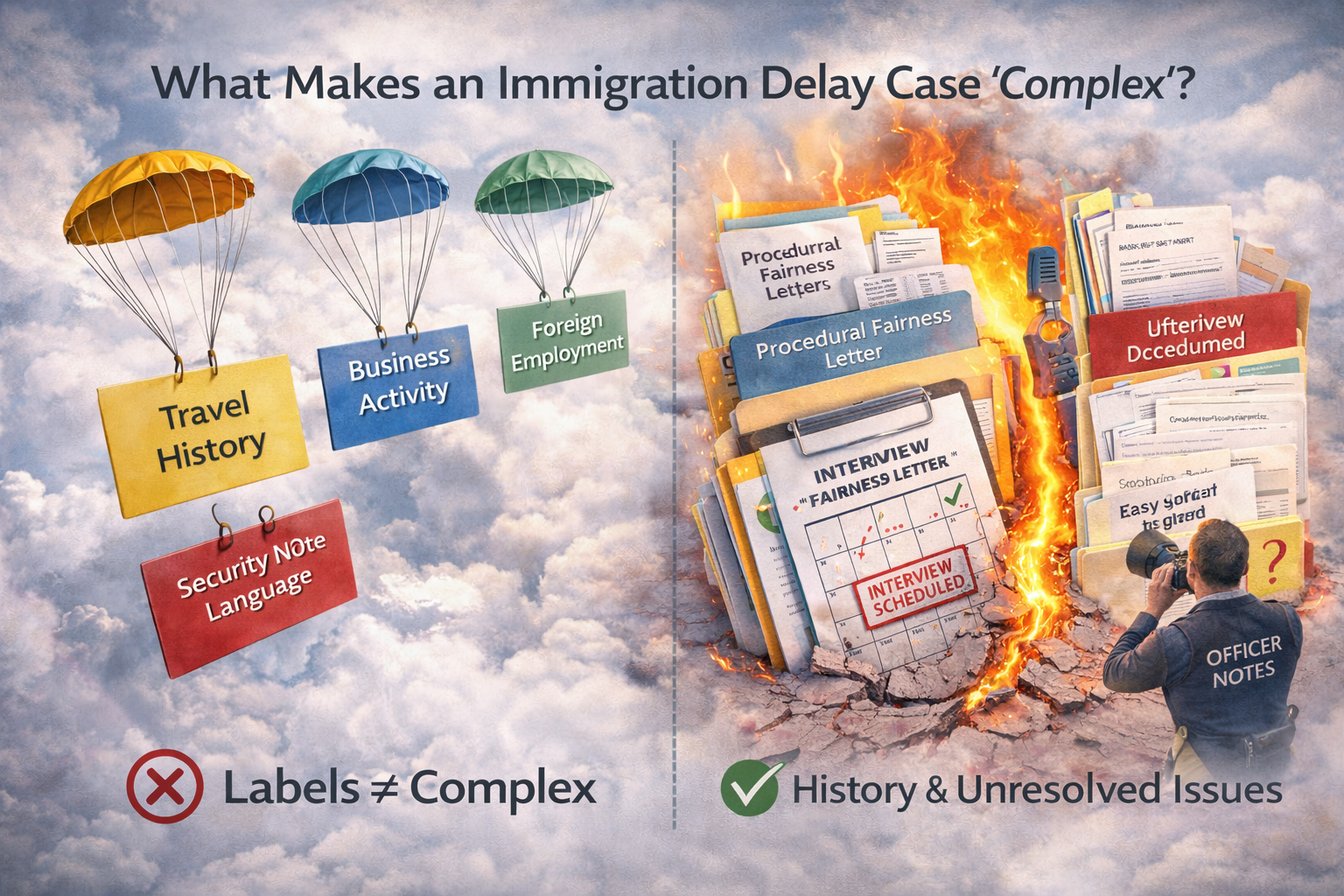
A file is not necessarily complex simply because it contains security-related language, some international travel, business activity, a foreign employer, or a cross-border element. Those factors may be relevant. What matters is whether the government can actually show why this particular file required materially more time than the process ordinarily demands.
That is the key distinction. True complexity must be demonstrated, not assumed.
Why this article is different from a security-screening article
This issue overlaps with security-screening delay arguments, but it is broader. The question here is not only whether pending screening justifies delay. The question is what kinds of facts genuinely make a file more complex, and what kinds of facts are merely generic labels dressed up as complexity.
That matters because respondent materials often move quickly from a broad statement — security is ongoing, partner information is pending, the file has foreign elements — to the conclusion that the application therefore falls outside normal timelines. Courts have repeatedly required more than that.
Complexity is not a mood. It is an evidentiary proposition.
What real complexity may look like
A genuinely complex delay case usually shows visible, file-specific signs of an evolving issue. There may be targeted requests for records. There may be an interview. There may be a procedural fairness letter identifying a concrete concern. There may be officer notes showing that a particular problem is being assessed over time.
In some files, true complexity may arise from a real inadmissibility issue, a genuine identity problem, an evolving security concern, or a document trail that requires follow-up with specific relevance to the applicant. In those situations, the record often shows more than a status label. It shows actual work tied to an identifiable issue.
That kind of record is very different from a file that simply says screening is in progress and then goes quiet.
What does not automatically make a file complex
A file is not automatically complex just because the applicant has travelled internationally. Many immigration applicants have travel history. That fact alone does not explain a prolonged delay.
A file is not automatically complex because the applicant has business activity, foreign work history, or cross-border professional ties. Those facts may require review, but they do not inherently justify years of inaction.
A file is not automatically complex because a GCMS note refers to security screening or says pending info from partners. Those labels may identify a stage in the process, but they do not explain the nature, timing, or actual difficulty of the work being done.
And a file is not automatically complex simply because the government says that security partners may be involved. The existence of a partner process is not the same as evidence that this file is unusually demanding.
Why courts look for specifics
Courts do not usually accept generic invocations of complexity at face value. They look for evidence showing what made the file different, what steps were taken, why those steps took so long, and whether the delay still remained proportionate to the issue under review.
That means the government generally needs more than a DOJ affidavit attaching generic website language about screening or complexity. It needs direct, file-specific evidence that explains the processing history. Without that, complexity can start to look like a conclusion rather than an explanation.
This is especially true where the file history shows long stretches of inactivity, repeated generic status replies, or last-minute movement shortly before a hearing.
Why generic security language often fails to prove complexity
Security language is one of the most common ways complexity is implied. A note may say screening in progress, pending screening, approved pending info from partners, or additional verifications. Those phrases sound significant, but they may reveal very little.
Unless the record also shows a concrete concern, meaningful activity, or some explanation of why the review is unusually long, those phrases often do not establish real complexity. At most, they identify where the file may be stuck.
In other words, a security label is not the same thing as a complex case. The label may be part of the story, but it is not the whole story.
Why visible inactivity undermines the complexity narrative
A true complexity argument becomes harder to sustain when the file appears dormant. If the record shows one or two early notes followed by many months of silence, that silence may weaken the claim that the file has been actively grappling with a difficult issue.
This is one of the most important practical points in delay litigation. Complex files usually leave traces: requests, reviews, interviews, clarifications, updated notes, or procedural steps. A file that looks mostly still may suggest not true complexity, but unresolved stagnation.
That does not mean every quiet period is unreasonable. It means the longer the silence, the more the government usually needs to explain it.
Why business activity and cross-border elements are often overstated
Applicants are sometimes left with the impression that any business activity, foreign corporate role, international conference work, or multi-country travel makes their file inherently exceptional. That is often overstated.
Modern immigration files frequently involve applicants who work across borders, travel internationally, maintain foreign employment, or operate businesses. Those features may call for review, but they are not extraordinary in themselves. What matters is whether they tie to an identified concern that actually required deeper scrutiny in the file.
Without that link, generic references to business or cross-border elements do not do much legal work.
What applicants and referral partners should ask
A useful practical question is not 'Has IRCC used serious-sounding language?' The better question is: what in the actual record shows that this file required more time than normal?
Are there specific requests? A procedural fairness step? A targeted concern? An interview? Repeated officer analysis tied to one identifiable issue? Or is the file mostly supported by generic notes and generalized submissions about how some files can be complex?
That distinction can help applicants and referral partners decide whether a delay should be treated as understandable, or whether it may deserve closer legal review.
Final takeaway
A delay case does not become complex merely because IRCC says it is. Real complexity usually leaves a visible record of evolving, file-specific work. Generic labels — security language, travel history, business activity, foreign ties, or cross-border elements — may be relevant, but they do not automatically justify prolonged delay.
In delay litigation, the question is not whether the file sounds serious in the abstract. It is whether the evidence actually shows why this file required this much time.
Frequently Asked Questions
Does security-related language automatically make a file complex?
No. Security-related language may identify a stage of review, but it does not automatically prove that the file is unusually complex or that the delay is justified.
Can travel history or foreign business activity alone explain long delay?
Usually not. Those factors may require review, but they are not inherently exceptional. The government still needs file-specific evidence showing why they actually required materially more time.
What is a sign of real complexity in a delay case?
Real complexity often appears through concrete procedural steps such as targeted document requests, interviews, procedural fairness letters, or officer notes showing an evolving issue under active review.
Why do gaps in activity matter when IRCC says a file is complex?
Because prolonged silence may suggest stagnation rather than active work. If a file is truly complex, the record often shows visible steps that reflect ongoing analysis.
If your file has been delayed and IRCC is suggesting that it is 'complex' without giving a real explanation, email us at [email protected] for a tailored review of the GCMS record and processing history.
Legal Information Disclaimer
The information provided here is for general informational purposes only and should not be considered legal advice. The content on this site is not intended to create, nor does it constitute a lawyer-client relationship. It's important to consult with a qualified attorney for advice on your specific legal issues.
No responsibility is assumed for any reliance on the information contained herein, and Canadian Future disclaims all liability with respect to such information. This site may not reflect the most current legal developments; therefore, the information here should not be used as a substitute for legal advice from a licensed professional attorney in your jurisdiction.
Leave a comment