



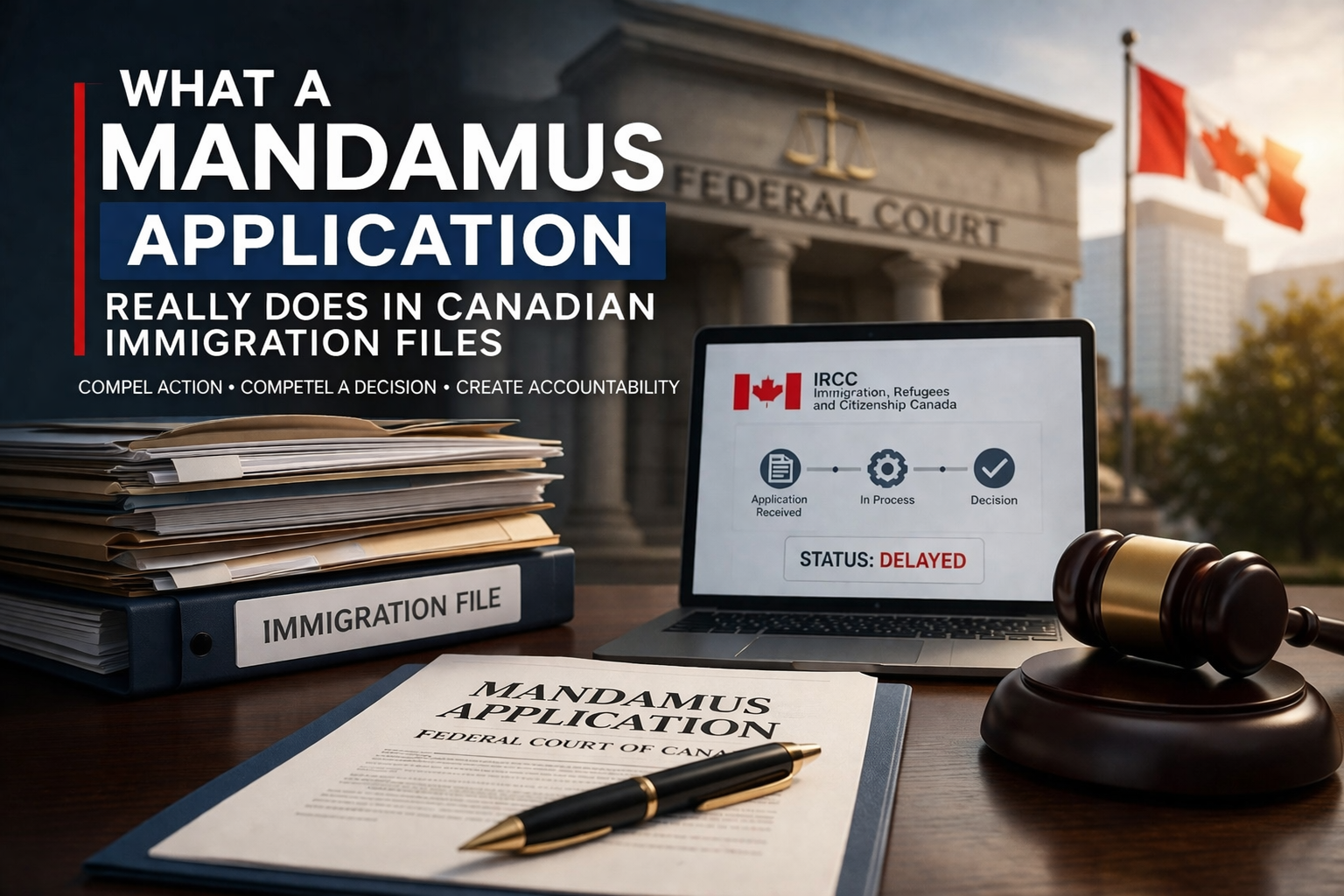
What a Mandamus Application Really Does in Canadian Immigration Files
What a Mandamus Application Really Does in Canadian Immigration Files
When people hear the word mandamus, they often imagine a court forcing IRCC to approve an immigration application. That is not what mandamus does.
A mandamus application is a serious Federal Court remedy used to address unlawful inaction or unreasonable delay by a federal decision-maker. In the immigration context, it is best understood as an accountability tool. It can push a stalled file forward, force the government to take a step it is legally required to take, or compel a decision where a file has been left sitting too long. But it does not allow the Court to simply grant the visa, permit, or permanent residence itself.
That distinction matters. It helps applicants understand both the power and the limits of this remedy.
What is a mandamus application?
Mandamus is a court order that compels a public authority to perform a legal duty it owes to the applicant. In the immigration context, that usually means the applicant argues that IRCC or another federal authority has failed to move the file forward within a legally acceptable time or has failed to make a decision it is required to make.
What mandamus can actually do
Mandamus can be extremely effective, but only when it is framed properly.
At its core, a successful mandamus application can do three things.
1. Compel action on a file
If the government has a legal duty to process an application and has unreasonably delayed doing so, the Court can order it to act. In practical terms, that can mean forcing movement in a file that has been sitting dormant.
2. Compel a decision
In some cases, the real goal is not just motion in the background but an actual decision within a defined period. That can be especially important when a file has already gone through most of its internal processing and there is no legitimate reason for continued silence.
3. Create accountability and pressure
Even before a case reaches a full hearing, mandamus litigation often forces the government to explain where the file is stuck, what has or has not been done, and why. That matters because once a delayed file enters a court process, unexplained inaction becomes much harder to maintain.
What mandamus cannot do
The Court does not approve the application. The Federal Court does not step into the shoes of the visa officer and issue a study permit, work permit, TRV, or permanent residence approval. Its role is supervisory, not administrative.
The Court does not guarantee a positive outcome. A successful mandamus application can force progress or a decision, but the eventual decision can still be a refusal. The legal right being enforced is usually the right to lawful, timely decision-making—not the right to approval.
Mandamus is not automatic just because a file is late. Delay alone is not always enough. The Court looks at the full context, including the nature of the delay, the explanation offered, and whether the applicant is otherwise entitled to have the duty performed.
When does mandamus become relevant in immigration cases?
Mandamus is usually considered where there is a prolonged delay and the government is not giving a satisfactory legal explanation for it. That can arise in permanent residence applications, citizenship files, work permit or study permit cases, or files where background or security screening is repeatedly invoked but the overall record shows little real progress.
Why mandamus is often misunderstood
Many applicants think of mandamus as a way to ‘win’ the immigration file. That is too simplistic. A better way to think about it is this: mandamus does not decide the application for IRCC, but it can stop IRCC from leaving the file in limbo when the law requires action.
How mandamus fits within judicial review
Mandamus is pursued through the Federal Court judicial review framework. That is why mandamus cases often follow the same broader litigation structure, including court timelines, the tribunal record, leave, and in some cases settlement discussions.
The practical reality: mandamus is a pressure tool, not magic
The strongest immigration mandamus cases are built on evidence. That may include the application timeline, GCMS notes, proof of follow-up efforts, inconsistencies in processing, signs of inactivity, or evidence of prejudice caused by the delay.
Final takeaway
A mandamus application is one of the most powerful tools available in Canadian immigration litigation—but only if it is understood properly. It can compel IRCC or another federal decision-maker to act, move a file, or make a decision when the law requires it. It cannot order the government to approve the application. It is a remedy for inaction and unreasonable delay, not a shortcut to the immigration result an applicant wants.
Frequently Asked Questions
Can mandamus make IRCC approve my application?
No. Mandamus can compel action or a decision, but it does not allow the Court to approve the application itself.
Can mandamus help if my immigration file has been delayed for a long time?
Potentially, yes. A long delay may justify mandamus where the government has a duty to act and the delay has become unreasonable in the circumstances.
Is mandamus the same as judicial review?
Mandamus is a remedy pursued within the Federal Court judicial review process. It is not a completely separate procedure.
Does mandamus guarantee a positive result?
No. Even where mandamus succeeds, the eventual decision can still be a refusal.
If your immigration file has been delayed and you want to understand whether mandamus may be appropriate, email us at [email protected].
Legal Information Disclaimer
Legal Disclaimer: The information provided here is for general informational purposes only and should not be considered legal advice. The content on this site is not intended to create, nor does it constitute a lawyer-client relationship. It's important to consult with a qualified attorney for advice on your specific legal issues.
No responsibility is assumed for any reliance on the information contained herein, and Canadian Future disclaims all liability with respect to such information. This site may not reflect the most current legal developments; therefore, the information here should not be used as a substitute for legal advice from a licensed professional attorney in your jurisdiction.
Leave a comment